


Crystal Ball Gazing…Predictions for the future of Costs Budgeting
Written by Thomas Spanyol
Whether the introduction of the Simplified Costs Budgeting Practice Directions (PD51ZG1-3) has the desired effect of making the process more proportionate to the complexity and value of the claim remains to be seen with it likely to be several months before the first of these cases filter through the process.
The proof of the pudding will, as ever, be in the eating, but the following issues seem to me to be ones that may well arise in the context of the simplified scheme:
Cases where no CMO is made
Given the default position for no Costs Management Order (“CMO”) to be made in cases under PD51ZG1 where the value of the claim is in the £1 million to £10 million bracket, it seems inevitable that we will see a lot more budgets that are filed, but where no CMO is made.
Looking to the past, the 20% difference in terms of costs claimed vs. costs estimated has always featured in the CPR. However, prior to the implementation of the Costs Budgeting rules in 2013 the Practice Direction was focussed on estimates of costs filed by parties at the allocation and listing stages of proceedings. An example of this previous (but similarly worded) Practice Direction in action can be found in Master Gord-Saker’s decision in Tribe v Southdown Gliding Club [2007] EWHC 90080 (Costs).
In Tribe, the Defendants (receiving party) had provided an estimate of costs at the allocation stage of £50,000. Following the Claimant proposing on 21 September 2005 that the claim be discontinued with no order as to costs, the Defendants provided an updated estimate with their Listing Questionnaire on 27 September 2005 indicating incurred costs at that point totalling £234,379.14. The Claimant then filed Notice of Discontinuance on 30 September 2005, thereby entitling the Defendants to their reasonable costs. The Bill of Costs served on behalf of the Defendants totalled £244,509.72 and the Claimant sought to argue that the Defendants’ costs should be limited to the sum estimated at the allocation stage, the Claimant having relied upon that estimate in that he did not seek to ‘top-up’ the After The Event adverse legal expenses cover that he had purchased with a limit of indemnity of £100,000.
In his judgment, Master Gordon-Saker accepted (to a limited extent) some of the explanations provided by the Defendants for the difference; and accepted that the Claimant had reasonably relied upon the estimate. As a consequence of this reliance, Master Gord-Skaer made a preliminary determination that the most that the Defendants could recover following Detailed Assessment would be £70,000 (less than 30% of the amount claimed).
I suggest the following practice points that can be taken from this in cases where budgets are filed and no CMO made:
- Even where it is likely that no CMO will be made, it remains important to prepare a Costs Budget that is as accurate as reasonably possible
- Monitoring the budget is essential, even where there is no CMO, in order to continue to provide clients with the best information about the cost of their case throughout (SRA Code of Conduct requirement)
- Advising clients on adverse costs exposure in relation to a budget filed by an opponent and recording any actions that the client takes with reference to this information may be key if you later need to show reliance on a budget
- Updating the estimate at the trial stage may not be enough to escape the 20% difference rule per the decision in Tribe
In conclusion, careful preparation and monitoring of any budget required to be filed will likely remain important, even where a CMO is not made.
Sanctions
It will be interesting to see how the wide discretion as to sanctions applicable by the Court for any failure to comply with the Practice Direction will be interpreted. For example: would failure to file and serve a pre-trial Precedent Z where the initial Precedent Z has been filed lead to the indicated sanction of being treated as having filed a budget consisting of Court fees only? That would seem somewhat draconian, but parties may seek to lead the Court down this sort of path until guidance is provided in decided cases under the new scheme.
Certification
The new Precedent Z includes the exact same certificate as Precedent H, namely attesting to the budget being a ‘fair and accurate statement of incurred and estimated costs which it would be reasonable and proportionate for my client to incur in this litigation’.
This certificate has garnered significant scrutiny and coverage in the legal press (and beyond) recently wherein Rooney’s solicitors had stated her incurred costs at approximately 55-60% of her actual incurred costs. Vardy argued initially that this amounted to misconduct. Rooney’s solicitors having explained that ‘the costs included within the Precedent H were those that, in the conducting solicitor’s view, it would be proportionate for the Defendant to incur in the litigation. That figure was lower than the actual costs incurred because it was considered that the actual costs incurred would be deemed to be disproportionate.’ Vardy then contended that having taken this approach, Rooney’s solicitors were obliged to be transparent about it. Mr Justice Cavanagh upheld Master Gordon-Saker’s judgment on the issue: namely that although Rooney’s solicitors had not been entirely transparent, their conduct had not strayed into misconduct per CPR 44.11.
It seems to me likely that some clarification could be provided within the rules (or the wording of budget certifications in the Precedent H/Z) to ensure that parties are open about whether the costs included in the budget are the full actual costs, or have been reduced from that amount. The content of the certification and the decision in Vardy -v- Rooney do however underscore the importance of taking care when embarking upon the budgeting process in all cases. Whilst we are here, I must thank Coleen Rooney, Rebekah Vardy and Prince Harry – without the recent press coverage of their legal costs wranglings, none of my family or friends would understand what a Costs Lawyer does!
How can Kain Knight help?
In addition to the services that you will be familiar with (preparing costs budgets and dealing with the court mandated process), we are also able to assist with monitoring actual costs with reference to any budget that has been filed (whether, or not, a CMO is made).
Our budget monitoring service involves solicitors providing us with billing details every billing cycle, we can then provide a short report highlighting any areas of concern and our advice on how to address those concerns, together with a graphical representation of the current spend vs. the budgeted amount (be that approved pursuant to a CMO, or otherwise).
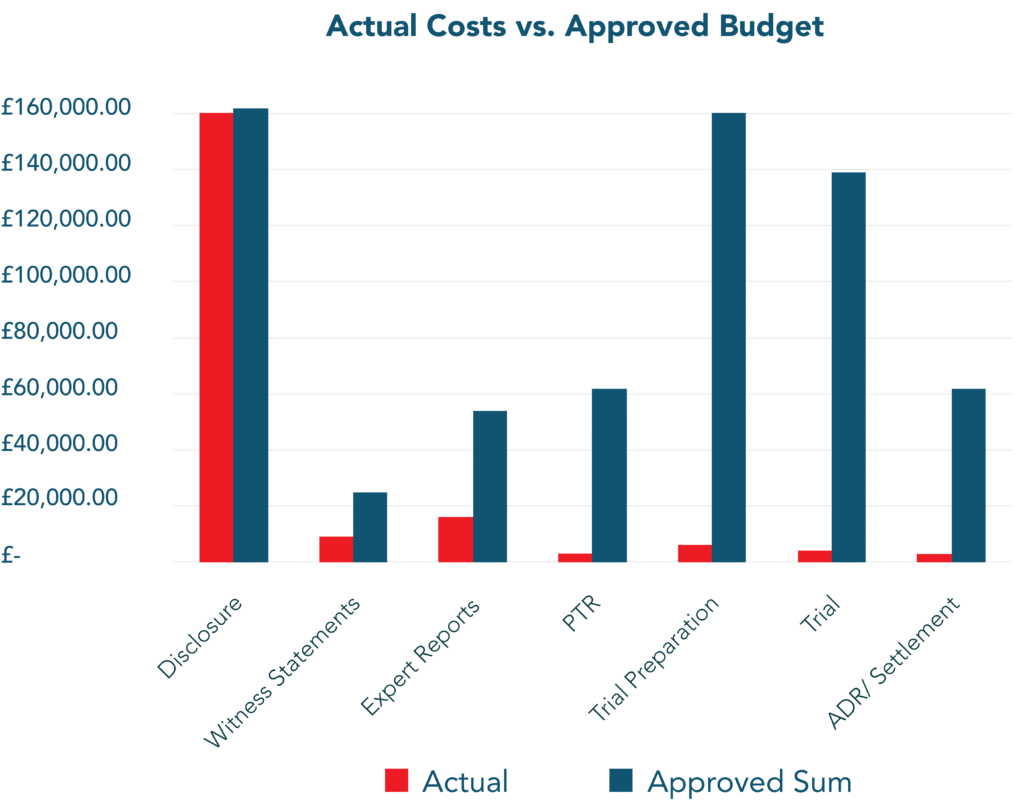
This assistance can usually be provided at relatively modest cost and would form part of the 2% allowance for recoverable costs of the costs management process under CPR 3.15(5) (so can be charged to clients and recovered from paying parties who may be ordered to pay adverse costs).
Feel free to contact anyone in our Commercial Costs team to receive a fee quote tailored to your requirements.
This article is the second part to Thomas’ overview of The Simplified Costs Budget Pilot Scheme

