



Is AI going to cost you your profits?
By Benjamin Wilson, Senior Associate.
Artificial intelligence (AI) has long been heralded as the game changing tool designed to aid modern life and, in recent times, has gained momentum as becoming the primary way of transforming how professionals go about their work. This all sounds great and, of course, who wouldn’t want assistance, typically at the fraction of the cost of additional staff, from an assistant who can turn something around instantly and never need a break. Whilst this sounds idyllic, it in fact, may not be as desirable as it sounds, especially for industries such as the legal market, who price their work with reference to hourly rates and the time spent. Typically, on a very basic level, traditional billing arrangements are centred around the more time spent, the greater the billing and, as a result, the greater the profits. In that light, maybe significantly reducing the time spent isn’t such a good thing…especially for the balance sheet.
So why do lawyers charge hourly? Although common practice for calculating legal fees, hourly rate charging has not been around for as long as some believe. Various iterations of the Law Society’s guidance on expense of time calculations were seen from the late 60’s through to the late 80’s, following which the use of hourly rates started to become the norm. At the time, the expense of time calculation was mainly a tool for management purposes rather than strictly relating to costs. Since then, we have seen the introduction of the Guideline Hourly Rates, thereby further solidifying hourly rates as the cornerstone for quantifying costs and billing. Is the introduction of AI (as well as other methods of streamlining services) the perfect time to re-evaluate the potentially outdated method of calculating a lawyer’s value by reference to the hourly rate and time spent only. I guess the first place to start is to ascertain whether AI is even encroaching into the traditional industry that is law.
The recent survey published by LexisNexis in September 2024, Fast law: why speed is the priority for lawyers using AI, found how “the number of lawyers in the UK using generative AI for work has almost quadrupled in a little over a year, with AI users jumping from 11% in July 2023 to 41% in September 2024 and with the percentage of lawyers planning to use AI also jumping from 28% to 41% over the same time period”.
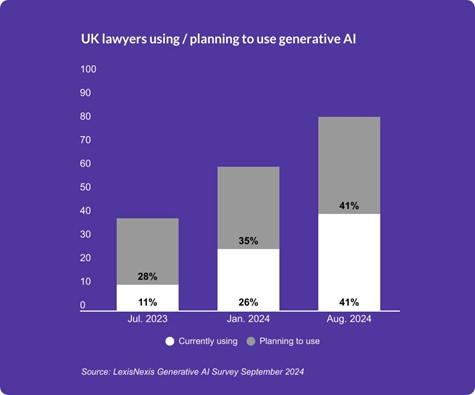
The survey also identified that “there has been a rise in activity taking place inside corporate in-house legal teams, jumping from 47% earlier this year to 74%. This was also true with the bar, rising from 8% to 32% throughout the year.”
There is no doubt that the delivery of faster work is a huge benefit of using AI, with “71% of lawyers citing delivering work faster as a key benefit of AI”, however, this ties back nicely to the original topic of pricing and billing. The survey also touched on this and found “39% of private practice lawyers expect to adjust their billing practices due to AI, which was up from only 18% in January 2024.” Turning to hourly rates specifically, only “17% of those in private practice think AI will end the billable hour model, while 40% believe it will remain in place and 42% are uncertain about its impact.” Clearly, there are varying degrees of uncertainty around billing methods, a topic which has never really been the source of much debate previously.
So, is delivering work quicker necessarily a good thing? No doubt it is better for the client, especially those paying by the hour, but increased efficiency may create issues that do not exist with traditional billing models. These issues are not necessarily a bad thing but may mean that billing arrangements need to be carefully considered at the outset of a matter. In instances where AI will no doubt speed up the process, it might be more advantageous to utilise a value-added model, where a fixed fee is agreed, calculated with reference to the value the lawyer is adding and, hopefully, a positive result. On the other hand, this might be a difficult sell to clients, who might be aware that the change to billing is only happening because of “less” work being done, yet they are expected to pay a similar fee.
This is looking at things on a simplistic time spent basis, however, one thing AI cannot bring to legal proceedings is experience and tactical know how, nor can it manage a situation, negotiate or undertake advocacy. Is it therefore going to become the case that for the preparation of documents (on the basis AI will assist) an appropriate fee agreement will be in place to reflect this and, for aspects of the case that require the non-drafting skills of a lawyer, the fees are charged in accordance with the traditional hourly rate model. This would also preserve the reputation of legal professionals, as it is not necessarily positive for lawyers to be viewed as individuals who largely check documents drafted by AI. To do so would undermine the skills and expertise of individuals who have dedicated most of their lives to the profession.
There is no doubt that AI will transform how lawyers practice, as AI tools research and draft in a matter of seconds, however, it does appear we are some way off the point where it can be truly trusted and relied upon. A Lawyer is only as good as their reputation and, as seen within a recent US matter where a legal team cited a fake case as a result of Chat GPT (Lawyer Used ChatGPT In Court—And Cited Fake Cases. A Judge Is Considering Sanctions (forbes.com)), it is still easy to over rely on AI and potentially undermine a case you have spent months (or years) perfecting. The LexisNexis survey reflects these concerns, with “76% of UK legal professionals concerned about inaccurate or fabricated information from public-access generative AI platforms.”
From a costs recovery perspective, how long will it be until we see challenges centred around AI? Will it be become the norm that a Bill of Costs is disputed on the fact that the receiving party should have utilised AI and has therefore incurred unreasonably high fees? Equally, will we see an AI cost claimed within a Bill of Costs or Budget, whether that be a proportion of a subscription cost or part of firm’s fee for implementing and maintaining their own system and, if so, do we expect costs judges to ascertain the reasonable running and implementation costs of AI? Or is factoring these costs into the hourly rate a way of addressing this issue, if hourly rates have been charged that is. In instances where a firm has pivoted to a value-added charging model, are there issues with assessing the costs claim if no hourly rates or time have been charged?
By contrast, if the matter has been conducted with reference to hourly rates, would the use of AI mean the hourly rates are reduced on assessment for certain tasks and not others, meaning multiple rates would need to be applied at assessment and to the Bill of Costs.
With regards to costs budgets, how long until we see a party maintain their costs budget as reasonable, whilst stating that it is in fact the other side’s budget that is unreasonably low as they have over relied on AI, a tool not necessarily accessible by all, especially smaller firms or individuals not as comfortable with technology.
Debates aside, you only have to look at the number of leading city firms implementing their own AI, or a similar bespoke tool, to appreciate that this is here for the long haul and the legal industry is going to continue along its transformative journey into the modern era. In terms of billing and costs, until the true extent and reliance on the technology is known, it is likely going to require a flexible approach and we may well see a move away from traditional billing methods as we continue along the path of AI….or possibly there is another billing arrangement we haven’t yet thought of, I would ask ChatGPT but I don’t want to give it any more ideas.
Benjamin Wilson is the Senior Associate within Kain Knight’s commercial team and has over 10 years costs experience in high value and complex commercial litigation.

Benjamin Wilson
Senior Associate
Office: 020 3889 0131
Direct Dial: 020 3889 0159
Kain Kight (City) Ltd
44 Southampton Buildings
London
WC2A 1AP

